
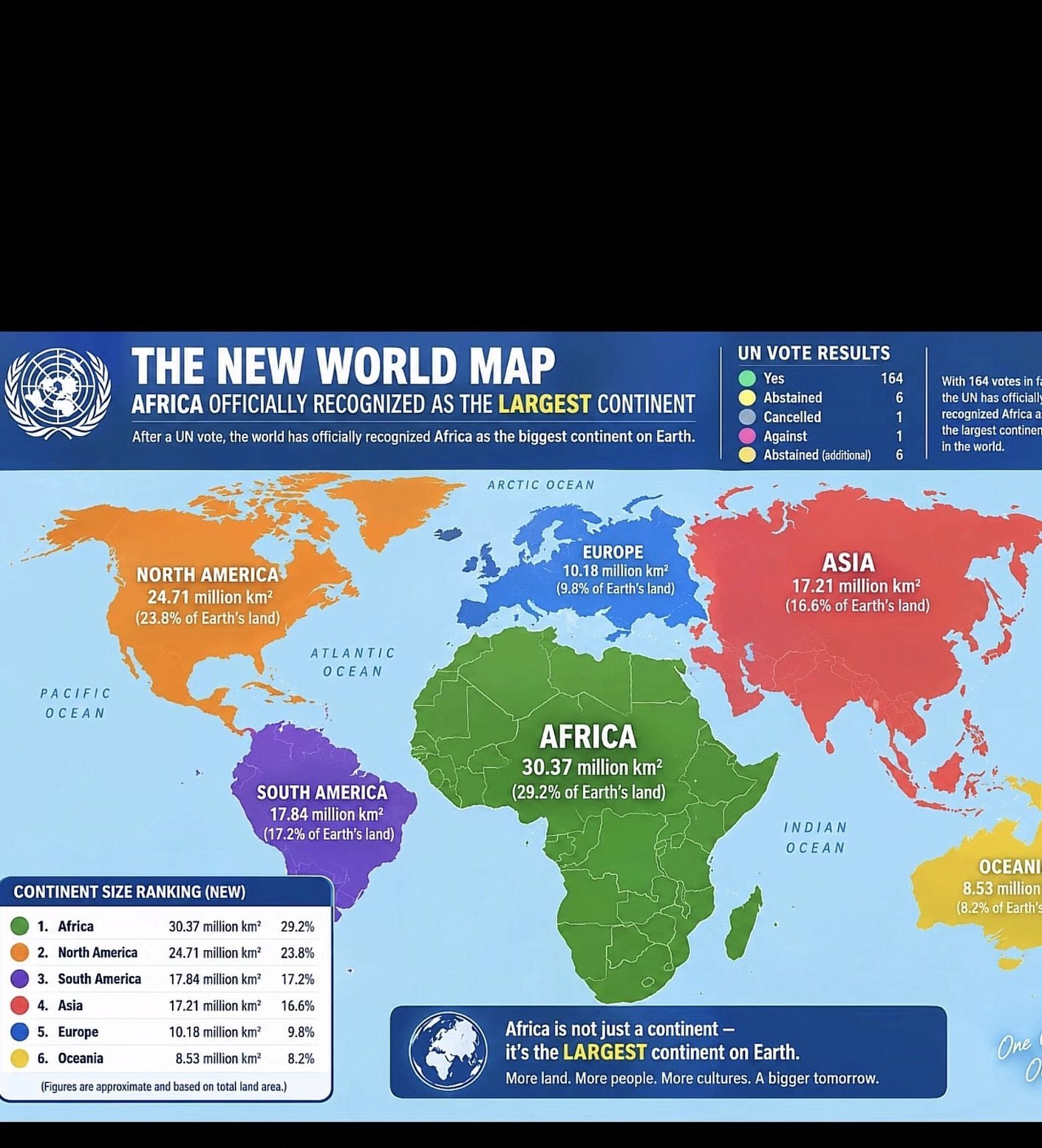
UN Votes To Retire Centuries Old Map That Made Africa Look Small, Only The US Says No
By Asiwaju Adekunle Saheed The United Nations General Assembly has voted to endorse a new world map that more accurately reflects Africa’s true size, in a resolution led by Togo and backed by African Union member states, marking the end of a campaign that had been building since 2025. The resolution, known as the Correct The Map initiative, passed by 164 votes in favour, with only the United States voting against it and six countries, Serbia, Estonia, Georgia, Lithuania, Moldova and Ukraine, abstaining from the vote. The measure encourages governments, schools and institutions worldwide to move away from the 16th century Mercator projection, which visually shrinks Africa and enlarges regions near the poles such as Greenland and North America, in favour of the 2018 Equal Earth projection that reflects continents in their true proportions. Togo’s Foreign Minister, Robert Dussey, told the General Assembly that maps shape how people understand the world, guiding education and influencing collective perceptions, and stressed that the effort was not meant to condemn the Mercator projection but to correct centuries of visual distortion. France, which co-sponsored the resolution, announced it would abandon the Mercator projection in its own materials, with French Foreign Minister Jean Noël Barrot noting that the United States, Russia and China had long taken on a disproportionate visual prominence compared to Africa, Latin America and Southeast Asia. The United States, however, dismissed the resolution as part of a broader ideological project, with its representative arguing that such initiatives distract the United Nations from more pressing matters of international peace and security. The resolution is non-binding and does not ban the Mercator projection outright, but advocates say its passage marks a symbolic turning point, one campaigners hope will eventually reshape classroom materials and digital maps across the world
Continue Reading